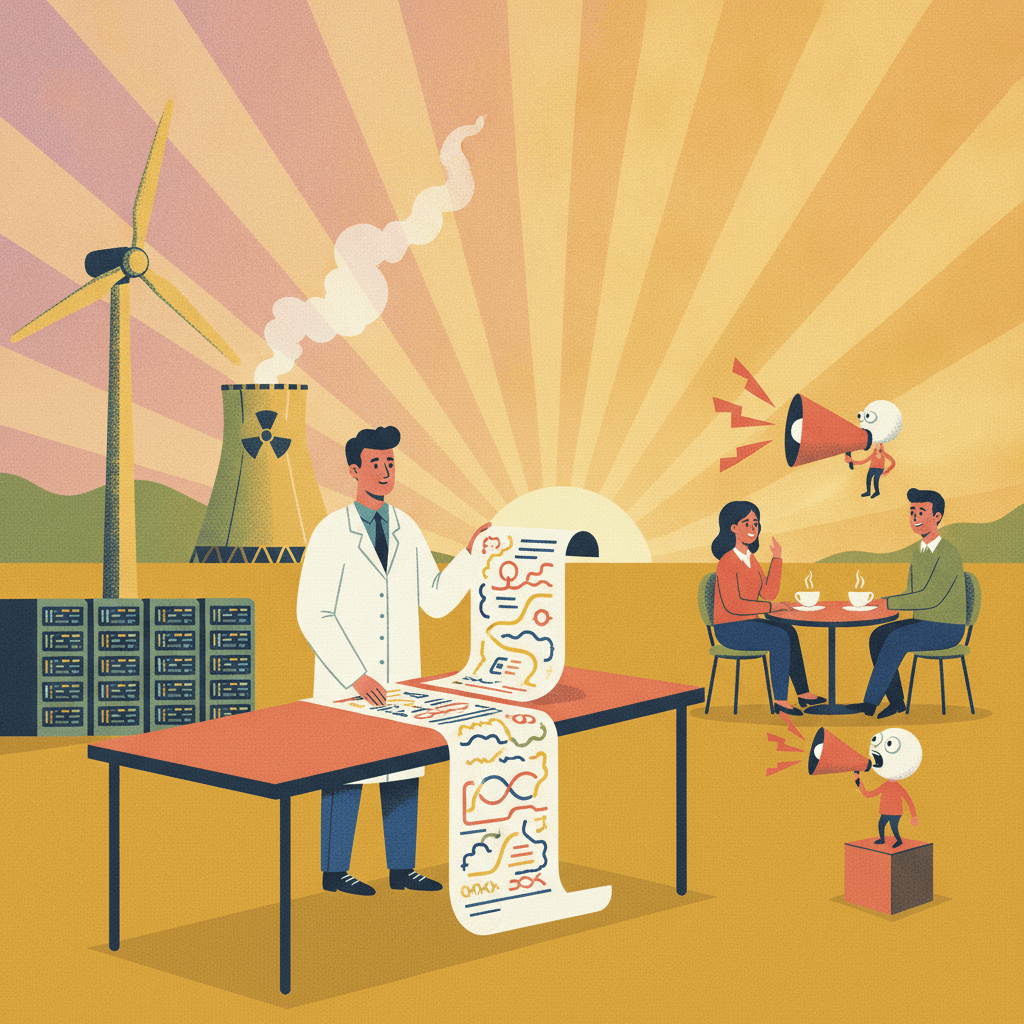
Nine billion. That’s how many possible single-letter DNA changes Google DeepMind just mapped in one shot this week, while a mathematician’s tweet about resigning got treated by half the internet like a doomsday clock. Real progress kept showing up in unglamorous places — a nuclear plant contract, a chip partnership, a robot that can build another robot. Meanwhile the loudest headlines were, as usual, about the least verifiable claims. Let’s sort the signal from the noise.
Worth Reading
- AlphaGenome Atlas maps every possible DNA variant — DeepMind pre-computed the predicted effects of all nine billion single-letter DNA changes into a free, petabyte-scale database, turning years of individual lab guesswork into a lookup table any researcher can query for free.
- Google commits $15.1 billion to Finland, with a nuclear twist — instead of just building more data centers and hoping the grid keeps up, Google signed a 22-year deal to keep an aging Finnish nuclear plant running through 2050, which is a far more boring and far more useful story than another chatbot demo.
- Qualcomm and Amazon team up on custom AI chips — Amazon is diversifying its AI hardware bets by getting Qualcomm to co-design inference silicon for AWS, a sign that even the biggest cloud providers don’t want to depend on a single chipmaker.
- OpenAI says it cracked a 90-year-old math problem — an internal, unreleased model reportedly worked through the Navier-Stokes Millennium Prize problem in 88 hours, and while the claim is genuinely exciting, it’s still unpublished, unverified, and tangled up in a credit dispute with outside mathematicians, which is exactly the kind of caveat that should stay attached to it until peer review says otherwise.
- XPeng’s humanoid robot walked off an actual production line — it’s a modest first step, not mass production, but XPeng turning a real assembly line on is a more concrete milestone than another flashy stage demo, especially with a rival’s factory line still stuck converting.
Spot the Hype
- OpenAI’s math proof will ‘revolutionize weather forecasting’ — it’s an abstract proof about a mathematical edge case that even physicists say doesn’t actually happen in real fluids, but sure, tell the meteorologists to clear their calendars.
- Feds warn China is ‘stealing’ American AI data — the underlying practice is called distillation, it’s a standard industry technique every major lab uses on itself, and calling it theft only when a rival does it is a framing choice, not a fact.
- AI whistleblowers warn AI ‘could kill all humans’ — a researcher quit his job, posted a thread, and by dinner time cable pundits on every side of the aisle were treating one person’s percentage estimate like a peer-reviewed prophecy.
Which headline made you roll your eyes hardest this week, the genome atlas or the doom tweet? Drop it in the comments — and if you missed it, catch last week’s digest here.


Leave a Reply