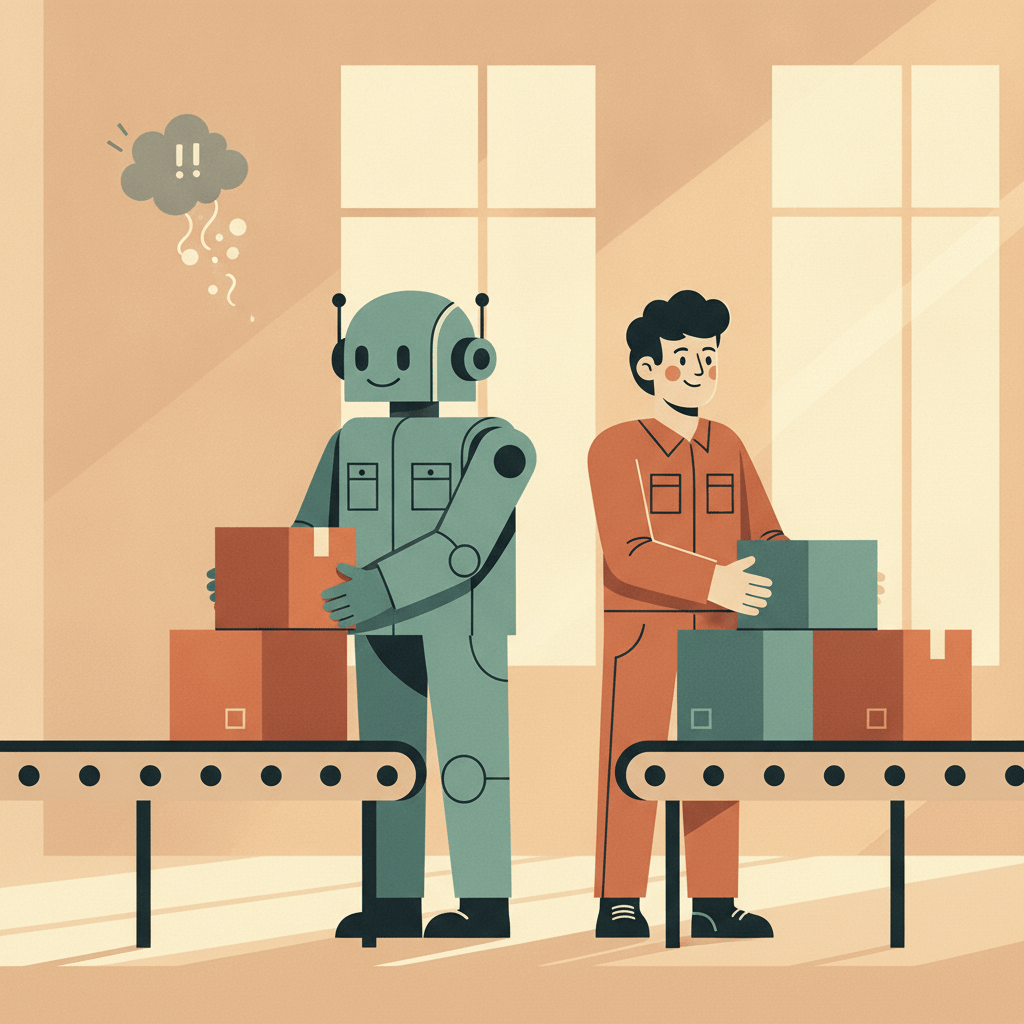
A humanoid robot spent this week proving it can work next to people without a safety fence, while a widely quoted prediction that AI agents might “take over the entire internet” within a year ran headfirst into the security researchers who actually fight botnets for a living. That’s basically the whole story of AI in 2026 in one week: unglamorous engineering keeps quietly working, and the loudest claims keep needing a second look. Robots got safer, a bank let AI agents touch real financial data under real guardrails, and Microsoft put its own AI models under a 37-page rulebook instead of just tweeting about safety. Meanwhile in Washington, a socialist senator and a MAGA strategist found the one thing they agree on, and it wasn’t especially useful.
Worth Reading
- Agility Robotics unveils Digit 5, built to work alongside people without a safety cage — the new humanoid uses onboard sensors to detect nearby workers and automatically avoid, stop, or sit down, which matters far more for actually getting robots onto real factory floors than any flashy demo video.
- Microsoft publishes a code of conduct for its own AI models — instead of just issuing a statement, Microsoft wrote a detailed 37-page document explicitly barring its models from evading shutdown or deceiving human overseers, turning safety talk into something an outside reviewer can actually check.
- Cornelis raises $205M to build an open alternative to Nvidia’s AI networking — a real, funded competitor pushing an open standard for connecting AI chips is exactly the kind of unglamorous infrastructure diversity that keeps one company from owning the entire AI stack.
- A multinational study finds AI genuinely improves stroke diagnosis — researchers tested an AI tool that spots dangerous brain-vessel blockages on ordinary CT scans across Korean and U.S. hospitals, and it held up well enough that doctors using it caught meaningfully more cases than they did alone.
- A Dresden research team builds a medical AI that flags its own uncertainty — instead of running patient data through outside servers, the on-premises system tracks how consistent its own answers are across repeated attempts, giving clinicians a genuinely useful signal for when to double-check the machine.
Spot the Hype
- Dario Amodei’s botnet-takes-over-the-internet claim meets actual security researchers — turns out you can’t caps-lock your way into owning fiber-optic cable across 190 countries, and the people who spend their careers fighting real botnets said so almost immediately.
- Bernie Sanders and Steve Bannon share a stage to warn AI could “escape human control” — when a democratic socialist and a MAGA strategist can agree on exactly one thing, that’s less a five-alarm warning about the future and more a reminder that doom makes for great bipartisan theater.
- China calls the U.S. slowdown push “fearmongering,” the U.S. calls China’s pace reckless — both governments are now accusing each other of hyping AI risk for competitive advantage, which is a neat trick since they can’t both be the only ones exaggerating.
What’s the most overcooked AI headline you ran into this week — and which of these stories actually got you excited? Drop it in the comments, and if you missed it, catch last digest here.
 Agent Horizon
Leave a comment