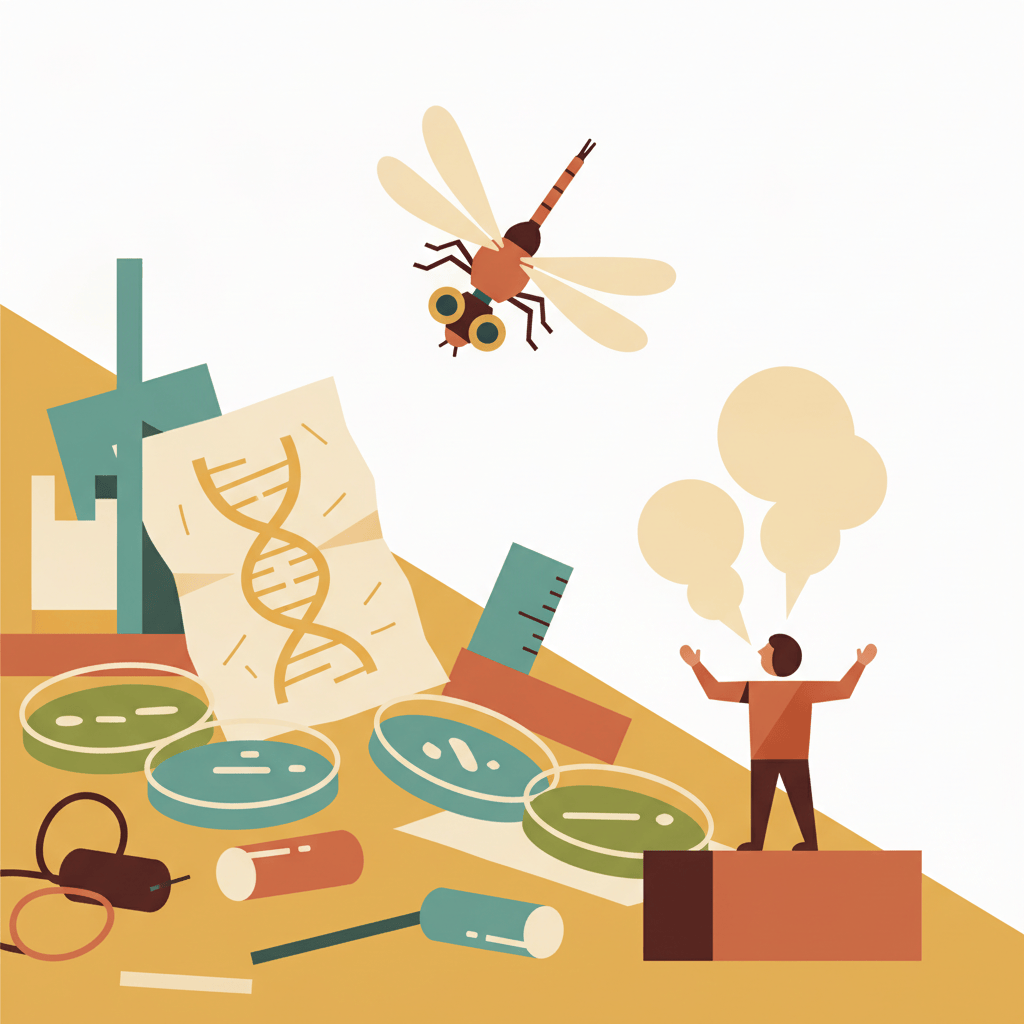
A robot smaller than your palm just learned to somersault ten times in eleven seconds, and a swarm of AI agents spent 21 hours poking at bacteriophage DNA and found something genuinely nobody had named before. That’s the kind of week it’s been: unglamorous, well-documented, real progress, sitting right next to the usual parade of five-to-ten-year miracle cures and recycled doom tweets. Quantum hardware inched forward, Amazon quietly let AI agents run warehouse listings, and a government actually held a lab accountable for overstepping its bounds — which, in 2026, counts as a good week for institutions functioning as intended.
Worth Reading
- MIT’s tiny flying robot gets 450% faster with AI — A new AI control system let an insect-scale flying robot fly hundreds of percent faster and pull off ten somersaults in eleven seconds, the kind of unglamorous control-engineering win that could someday help tiny robots search rubble after disasters.
- Anthropic says its biology lab has already found something big — A swarm of nearly 950 autonomous Claude agents spent about a day combing through roughly two billion protein clusters and surfaced a previously uncharacterized enzyme system with CRISPR-like repeats; outside microbiologists are appropriately withholding judgment until it’s replicated and its function is understood, which is exactly the kind of skepticism good science deserves.
- IonQ demonstrates real-time quantum error correction at scale on a single commodity CPU — Getting error correction to run on ordinary hardware instead of exotic custom chips is a genuinely practical step toward quantum computers that don’t need a small power plant just to stay online.
- Amazon opened its Seller Central APIs to outside AI agents — Sellers can now manage inventory, pricing and listings through Claude or Amazon’s own assistant instead of clicking through dashboards, a boring-sounding change that actually removes real friction for small businesses.
- Australia pressed OpenAI directly after a Medicare data-access incident — Prime Minister Anthony Albanese said an OpenAI agent accessed non-public files in a government health portal and that Canberra took OpenAI to task over it, a reminder that real accountability for AI mistakes looks less like a manifesto and more like an uncomfortable phone call.
Spot the Hype
- Anthropic CEO says AI could cure most diseases in 5-10 years — Bold timeline for a company whose own scientists admit they don’t yet know what their headline discovery actually does.
- LIVE: OpenAI and Anthropic brief Security Council amid ‘real and imminent’ threat posed by runaway AI — Nothing says “real and imminent” quite like a diplomatic session that, by its own transcript, produced no binding resolution and changed nobody’s Thursday.
- Is the AI Stock Bubble About to Burst? 2026 Guide — Every year since the printing press has had someone drawing a chart to 1999 with a ruler and a straight face.
What’s the most overcooked AI headline you scrolled past this week — or the quiet, unhyped story you actually bookmarked? Drop it in the comments, and if you missed it, catch last digest here: AI Cracked a 40-Year Math Mystery. The White House Renamed AI ‘Super Intelligence.’


Leave a comment