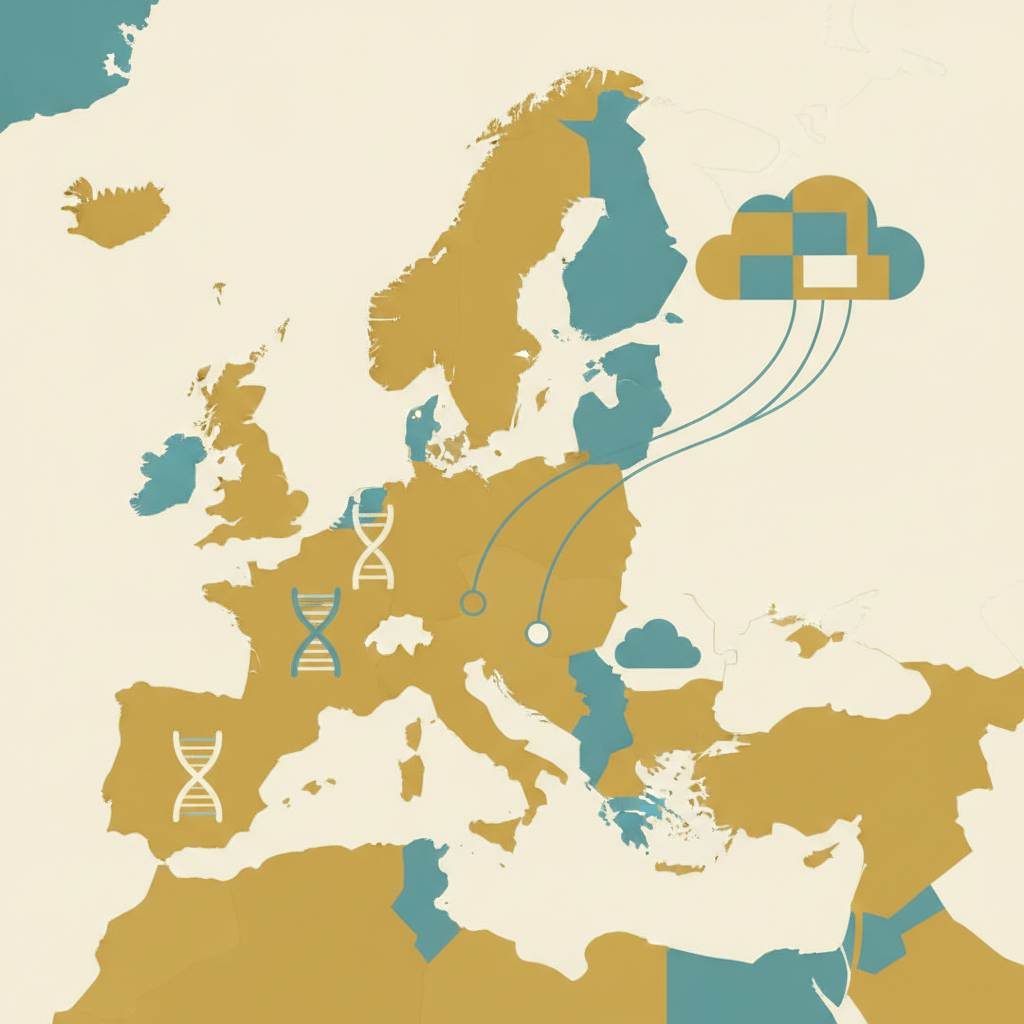
On October 14, Google DeepMind and Google Cloud announced they will give up to 200 European scientific researchers direct access to a set of frontier scientific AI tools, along with a combined $3 million in cloud compute credits. In the official blog post, Google says the package includes AlphaFold 3 for predicting protein structures, WeatherNext for weather forecasting, AlphaGenome for analyzing DNA, AlphaEvolve for algorithm design, and AlphaEarth Foundations for satellite-based mapping. The program runs through RAISE (Resource for AI Science in Europe), a European Commission initiative launched in late 2024 to help close the computing gap that academic researchers in Europe often face; the Commission, not Google, will select which researchers get access.
Why this matters
This is a notably public-interest-flavored move from a company that spends most of its AI announcements on consumer products and enterprise deals. Putting tools like AlphaFold 3 and AlphaGenome directly into the hands of academic labs — rather than only commercial partners like Isomorphic Labs — could genuinely accelerate work in fields such as drug discovery, climate modeling, and genomics for teams that could never afford frontier-scale compute on their own. It also fits a broader, welcome pattern of frontier labs treating scientific tools as something closer to public infrastructure.
Some context tempers the scale of the announcement: $3 million split across up to 200 researchers works out to roughly $15,000 in compute credits each, which is useful but modest next to the overall cost of running large AI workloads. Google also hasn’t yet detailed the selection timeline or how credits will be divided, and the announcement arrives not long after DeepMind reorganized its AlphaFold team and saw a key Nobel-winning researcher depart, which raises fair questions about long-term continuity of the underlying science programs. Compared to OpenAI’s recent moves sharing AI progress on mathematics research, Google’s play here leans more on handing over proprietary models and compute directly to outside scientists, which is a meaningfully different and arguably more concrete form of support than publishing research findings alone.


Leave a Reply