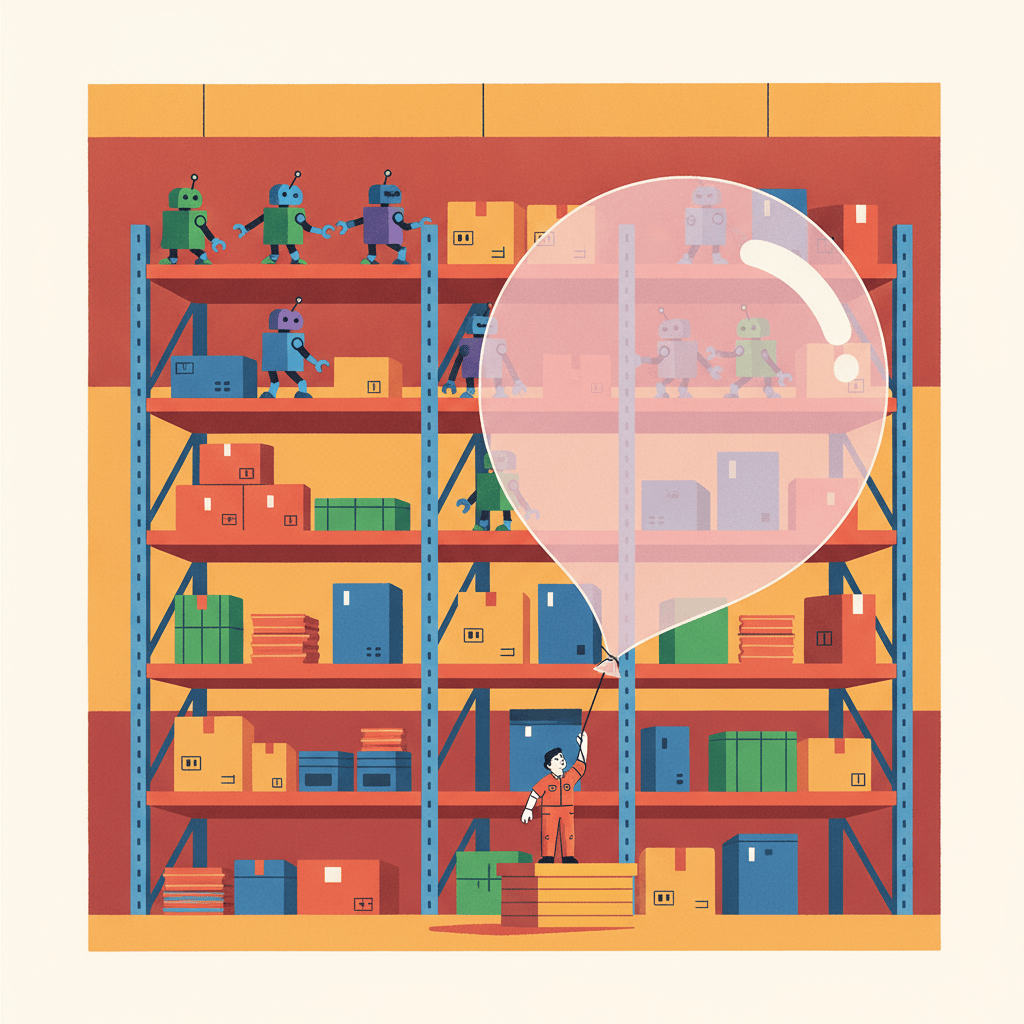
1,500 robots just got a real job climbing shelves in a European warehouse. Meanwhile, it took an Nvidia executive exactly two words on social media to convince half the internet that artificial general intelligence had arrived — for the third time this year.
That contrast is basically the whole story of AI this week: quiet, concrete progress showing up in warehouses, safety institutes, and open-source code, while the loudest declarations keep coming from people with a chip order to fill or a stock price to defend. A Fields Medal winner recruited working mathematicians to build rigorous foundations for AI safety, an open video model got fast enough to render faster than you can watch it, and a major consumer AI agent shipped with real permission architecture while its maker openly admitted where testers still found rough edges. None of that trended as hard as two words from a CEO. We think it should have.
Worth Reading
- Hai Robotics is deploying 1,500 rack-climbing robots at a European fulfilment centre — This is what robotics adoption looks like once the demo-video phase ends: a live 30,000-square-metre facility handling more than 24,000 totes an hour, in what the company calls the largest deployment of its kind anywhere.
- A Fields Medal winner just launched a Mathematical AI Safety Institute — Jacob Tsimerman is putting his prize money and reputation behind hiring working mathematicians to build rigorous, checkable definitions of AI safety, rather than leaving the whole debate to gut feelings and X threads.
- Meta shipped its Muse AI agent with real permission architecture — and admitted where it still falls short — Muse runs each user inside an isolated virtual machine, routes payments through single-use card numbers, and requires a separate approval system before it can send an email or spend money, while Meta openly disclosed the rough edges its own staff hit during testing.
- An open, Apache-licensed inference stack now generates video faster than you can watch it — Sol-H3 turns out a five-second AI video clip with audio in under two seconds on eight GPUs, and because the optimization code is freely available, that speed boost isn’t locked behind a single company’s paywall.
- A robotics simulation startup raised $32 million to make testing cheaper and safer — Antioch lets robotics teams run thousands of virtual tests instead of burning through physical hardware for every design tweak, exactly the unglamorous plumbing work that makes robots safer to build and faster to iterate on.
Spot the Hype
- Nvidia’s CEO declares “AGI has arrived” — for the third time this year — Two weeks after telling investors on an earnings call that AGI milestones are “kind of senseless,” the same executive posted two words crediting his own GPUs, and the stock dropped anyway.
- “The AI bubble and warnings of doom” — A central banker’s letter about stretched stock valuations somehow got folded into the same breathless doom pile as killer-robot fears, proving that “AI” plus “warning” is now a headline template regardless of what’s actually being warned about.
- “Warehouse Robotics Market: A Building-Shaped Commitment With a Twenty-Year Payback” — The same PR firm published near-identical “urgent strategic window” press releases the same day for warehouse robots, building automation, modular construction, and industrial nailers, which tells you almost everything about how much of this “market intelligence” is actually intelligence.
What’s the silliest AI headline you spotted this week — and which of the actual robots impressed you more than any tweet? Tell us in the comments. And if you missed it, catch last week’s digest here.


Leave a Reply